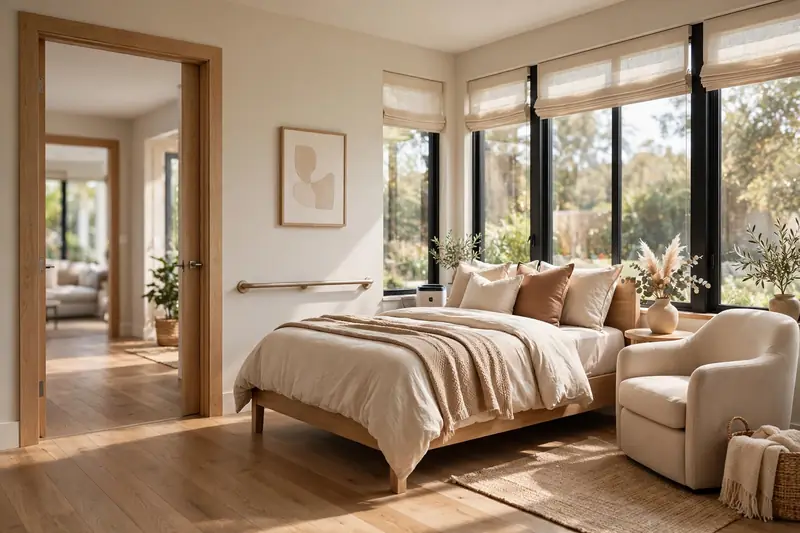
What "aging in place" means
Aging in place means staying in your own home and community as the years add up — not moving to a facility when the stairs win. An ADU built for aging in place is the plan made real: a safe, single-level home on your own lot, ready long before it is needed. See how families use one for aging parents.
It can house a parent today and you tomorrow. Or you now, with a caregiver later. The point is the same: the home is ready, so a health change never forces a housing crisis.
The features that matter most
- No-step entry. One gentle slope or low ramp instead of stairs. Walkers and wheelchairs roll straight in.
- Curbless shower with bench and grab bars. No tub wall to climb over. The bench and bars make bathing safe alone.
- 36-inch doors and hallways. Standard 30-inch doors trap wheelchairs. Wide openings keep every room reachable.
- Bedroom and full bath on the main level. Daily life happens on one floor — no stairs, ever.
- Lever door handles. Push down instead of grip and twist. Arthritic hands can manage them.
- Rocker light switches. A flat push instead of a tiny toggle.
- Bright, even lighting. No dark hallways. Falls drop when you can see.
- Slip-resistant floors. Matte tile and textured vinyl beat glossy surfaces.
One level beats two
Stairs are the enemy of aging in place. Even when a parent is spry today, we design the daily routine — bedroom, bath, kitchen, laundry — on one floor. A second level can exist for guests, but nobody's health should depend on climbing to it.
Attached or detached?
An attached in-law suite means no yard to cross in rain or ice — the safest walk is the shortest one. A detached cottage means more privacy and a clearer "my own home" feeling. Both can be fully accessible.
One draft-rule detail for attached ADUs: the county's published draft says the attached entry and any stairs must not be visible from the street. We design around that from the first sketch. See the full attached option at our attached ADUs page.
Sources: Charles County Bill 2026-06 / ZTA 25-189 (published draft), §3.01.700.I.
County rules, in plain English
Accessible ADUs follow the same county rules as every ADU. Under the published draft: lots under 3 acres cap at 1,000 square feet or 75% of the main home's floor area, whichever is smaller; 3+ acre lots cap at 75% with no absolute number. Maximum 2 bedrooms, one ADU per lot.
One rule helps compact accessible designs: Maryland state law sets no minimum ADU size, and the county's draft deleted the old 300-square-foot floor — the minimum is now the building code. A small, efficient, fully accessible footprint is legal. We build accessible ADUs across our service areas.
Sources: Charles County Bill 2026-06 / ZTA 25-189 (published draft), §§3.01.700.F, G; Chapter 197 of the 2025 Laws of Maryland (HB 1466/SB 891), §§4-501, 4-504(C)(1).
What it costs
Accessible features — the curbless shower, wider doors, grab bars, no-step entry — add a bit to the build. But they cost far less than tearing out a standard bathroom and doorway set five years from now. Build it right once.
A note on prices: material costs move up and down, and no two lots need the same work. Treat any numbers on this page as starting points, not quotes. Your written estimate after our free lot walk is the real number for your project.
If your neighborhood has an HOA, bring the CC&Rs to the first visit — the county's staff position is "HOA guidelines apply," so the HOA's architectural rules still matter. Get their approval in writing early.
Check it yourself — or skip the homework
Don't take our word for any of this. Zoning and permit questions: Charles County Planning & Growth Management, 301-645-0692. Well and septic questions: Health Department, Division of Environmental Health, 301-609-6751. The county's published draft rules are Bill 2026-06 / ZTA 25-189 ("Flexibility for Accessory Dwelling Units"); the state law is Chapter 197 of the 2025 Laws of Maryland (HB 1466/SB 891).
Or skip the homework: call (240) 222-5082 and we'll walk your lot free and tell you what your county allows — before you spend a dollar.