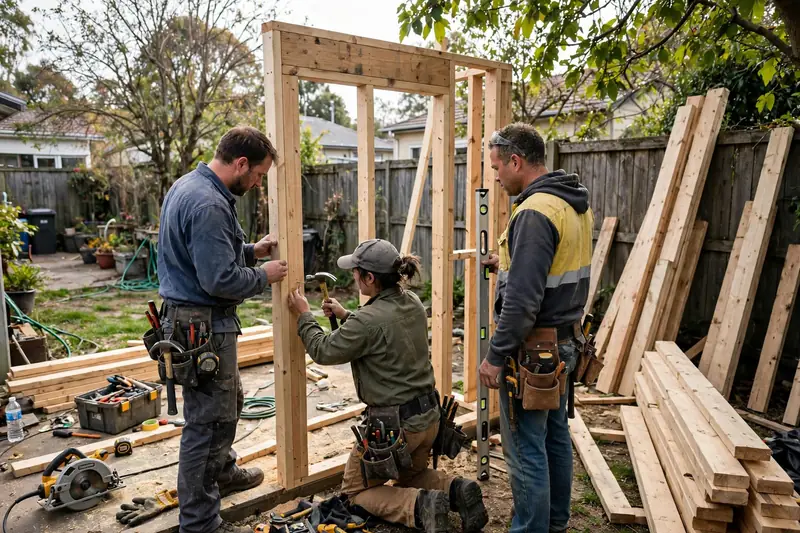
What "prefab" really means
"Prefab" covers three different things. Modular: whole rooms built in a factory, trucked to your lot, and set on your foundation with a crane. Panelized: walls and roof sections built flat in a factory, then assembled on your site like a kit. Manufactured or mobile: built to a federal code on a steel chassis — a different animal entirely.
That last one matters in Charles County: the county's published draft rules say an ADU cannot be a mobile home. Modular and panelized are fine; a mobile home on a chassis is not an ADU path.
Sources: Charles County Bill 2026-06 / ZTA 25-189 (published draft), §3.01.700.H.
What the factory changes
Three things, and they are real. Precision: walls built indoors on jigs come out square and tight. Weather: your framing never sits in the rain. Schedule overlap: the factory can build your rooms while we dig your foundation — the middle of the project compresses. (These are industry-typical advantages, not guarantees for your project.)
Prefab pairs well with a custom design mindset: pick the factory system that fits your lot, then let the site work follow.
What the factory can't change
The county does not care where your walls were built. Every prefab ADU still needs: a dedicated Accessory Dwelling Unit Permit from the zoning administrator before any building permit or excavation; health-department approval of your water supply and sewage disposal before any building or ADU permit; and the same setbacks, height limits, size caps, and bedroom caps as a site-built ADU.
Same rules, same fees, same inspections. The factory changes construction, not permission.
Sources: Charles County Bill 2026-06 / ZTA 25-189 (published draft), §297-430.E and §§3.01.700.D, J.
The cost question
Factory savings are real but not magic. You may save on framing labor and weather delays. You will not save on the foundation, the utility hookups, the permits, the health-department work, or the site preparation — those cost the same whether the walls come from a factory or a lumberyard. Crane day and transport add costs a site build never has.
The honest comparison is total project to total project, on your lot. That is what our written estimate gives you.
A note on prices: material costs move up and down, and no two lots need the same work. Treat any numbers on this page as starting points, not quotes. Your written estimate after our free lot walk is the real number for your project.
The timeline question
Makara ADU, quoted in The Banner, puts ADU construction at about 3–4 months — their figure, for the build phase. Excell Homes publishes a fuller picture: 5–7 months from start to move-in, broken into 2–3 weeks of design, 30–60 days of permits, and 12–16 weeks of building. Those are their published figures, not promises.
Prefab can shorten the middle of that timeline. It cannot shorten the permit line — and Charles County's review timelines are unverified, so we make no promises about them. See the full sequence at our permits and approvals page.
A note on prices: material costs move up and down, and no two lots need the same work. Treat any numbers on this page as starting points, not quotes. Your written estimate after our free lot walk is the real number for your project.
Sources: Makara ADU (quoted in The Banner); Excell Homes (published).
If your neighborhood has an HOA, bring the CC&Rs to the first visit — the county's staff position is "HOA guidelines apply," so the HOA's architectural rules still matter. Get their approval in writing early.
Check it yourself — or skip the homework
Don't take our word for any of this. Zoning and permit questions: Charles County Planning & Growth Management, 301-645-0692. Well and septic questions: Health Department, Division of Environmental Health, 301-609-6751. The county's published draft rules are Bill 2026-06 / ZTA 25-189 ("Flexibility for Accessory Dwelling Units"); the state law is Chapter 197 of the 2025 Laws of Maryland (HB 1466/SB 891).
Or skip the homework: call (240) 222-5082 and we'll walk your lot free and tell you what your county allows — before you spend a dollar. We build across our service areas, and the cottage design angle lives at backyard cottages.