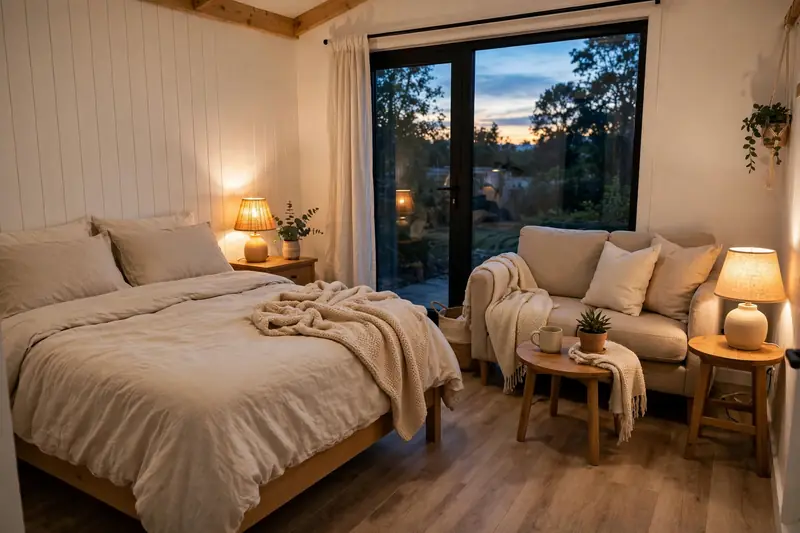
Why separate beats the spare room
The spare room fails in three ways: noise bleeds through, the door never really closes, and work colonizes your home. A detached office fixes all three. You walk thirty steps, shut a real door, and work in quiet. At five o'clock you walk back and leave work behind — physically, not just mentally.
This page covers the building itself: what goes inside and how it gets permitted. For the work-from-home lifestyle side, see using an ADU as a home office.
What's inside
- Sound insulation. Upgraded wall and ceiling insulation so calls stay private and the mower stays outside.
- Dedicated electrical circuits. Your workstation, monitors, and printers get their own circuits — no tripped breakers when the space heater kicks on.
- Wired ethernet plus a wifi access point. A hard line for video calls that cannot drop, and strong wifi for everything else.
- Mini-split heat and cooling. Quiet, efficient, zoned to the office alone — no robbing the house's system.
- Real daylight. Big windows beat overhead fluorescents for eight-hour days.
- A half or full bath. Once you have it, you will wonder how you worked without it.
How small can it be?
Smaller than you think. Maryland state law sets no minimum ADU size, and Charles County's published draft deleted the old 300-square-foot floor — the minimum is now the building code. A tight, well-drawn 300–400 square foot office is legal.
Small also saves on fees: ADUs under 750 square feet pay no development impact fee and no building excise tax under state law.
Sources: Chapter 197 of the 2025 Laws of Maryland (HB 1466/SB 891), §§4-501, 4-504(C)(1), 4-506; Charles County Bill 2026-06 / ZTA 25-189 (published draft), §§3.01.700.F, G.
ADU or a backyard office shed?
Here is the fork in the road. A plain office with no plumbing may follow a different, simpler permit path than a full ADU. But it will never be a legal second home — no kitchen, no bath, no future as a rental or guest suite. A permitted ADU costs more and does more.
Which path fits your address and your plans? We will check and tell you straight on the lot walk. See also our small ADUs for compact footprints.
Can clients visit?
Parking is not the barrier. The county's published draft requires NO off-street parking spaces for ADUs, and state law caps any new parking requirement at one space outside transit areas.
Home-business rules are a separate question from parking, and they vary. We will check what your address allows before you plan around client visits.
Sources: Charles County Bill 2026-06 / ZTA 25-189 (published draft), amending §297-335; Chapter 197 of the 2025 Laws of Maryland (HB 1466/SB 891), §4-504(D)(4).
Office now, guest room or rental later
A permitted ADU is a legal second home from day one. When remote work ends or life changes, the same building becomes a guest suite or a teen's space. For the cottage design angle, see our backyard cottages. We build across Charles County and Southern Maryland. Build it once, use it for decades. Durable choices pay twice.
What a home-office ADU costs
Foster Remodeling, a Northern Virginia remodeler, publishes $50K–$200K for conversion-type projects — their figure, for their market. Powell Custom Homes publishes $150–$300 per square foot as an industry-typical range. A simple detached office lands lighter than a full cottage because the footprint is small; plumbing and permits still cost real money.
A note on prices: material costs move up and down, and no two lots need the same work. Treat any numbers on this page as starting points, not quotes. Your written estimate after our free lot walk is the real number for your project.
Sources: Foster Remodeling (published); Powell Custom Homes (published, industry-wide).
If your neighborhood has an HOA, bring the CC&Rs to the first visit — the county's staff position is "HOA guidelines apply," so the HOA's architectural rules still matter. Get their approval in writing early.
Check it yourself — or skip the homework
Don't take our word for any of this. Zoning and permit questions: Charles County Planning & Growth Management, 301-645-0692. Well and septic questions: Health Department, Division of Environmental Health, 301-609-6751. The county's published draft rules are Bill 2026-06 / ZTA 25-189 ("Flexibility for Accessory Dwelling Units"); the state law is Chapter 197 of the 2025 Laws of Maryland (HB 1466/SB 891).
Or skip the homework: call (240) 222-5082 and we'll walk your lot free and tell you what your county allows — before you spend a dollar.