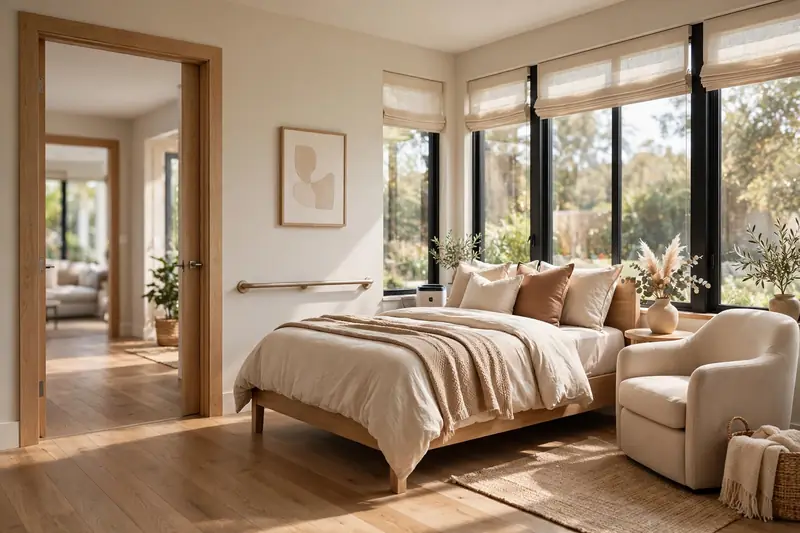
Why families choose this
She does not want a facility. You do not want her forty minutes away. An ADU on your lot gives your parent her own front door, her own kitchen, and her own schedule — with family twenty steps away instead of a phone call away. Many families weigh this against the cost of assisted living or a retirement community — and for a lot of them, one build beats years of monthly bills.
Attached or detached — which fits your parent?
An in-law suite attached to your house means no yard to cross at night. Mom walks through one connected home, not across a dark lawn, and help is one wall away. A detached cottage gives the most privacy: her own building, her own porch, her own quiet. The county treats the two types a little differently — our attached ADU guide explains the setback and entry rules for space joined to the house — but both follow the same permit path: a county ADU permit first, then building permits.
Sources: Charles County Bill 2026-06 / ZTA 25-189 (published draft, §§3.01.700.E–I, Art. XXVI §297-430.E).
Designed for safety, not just comfort
A parent's ADU is designed around the hard parts of aging. Start with a no-step entry, so there is never a stair to fall on. Add a walk-in shower with grab bars and a bench. Make doorways wide enough for a walker. Put bright lighting in every room. Our aging-in-place ADU page has the full safety checklist. Build these in from day one — adding them later costs far more.
Privacy for both generations
Closeness only works with a door that closes. A good parent ADU has its own entrance, sound insulation in any shared wall, and its own thermostat — so she sets her temperature, you set yours, and nobody hears the 6 a.m. news through the drywall. Together for dinner; apart for everything else.
When she no longer needs it
This is the question families are shy about asking, so we will answer it: the ADU does not go to waste. A properly permitted unit becomes a long-term rental, a guest space, or a home office. Build it legal now — with the county ADU permit — and it keeps working for the family for decades. More questions? See the main ADU FAQ.
Sources: Chapter 197 of the 2025 Laws of Maryland (HB 1466/SB 891) — no long-term rental ban in the statute; Charles County Bill 2026-06 / ZTA 25-189 (published draft, Art. XXVI §297-430.E).
If your neighborhood has an HOA, bring the CC&Rs to the first visit — the county's staff position is "HOA guidelines apply," so the HOA's architectural rules still matter. Get their approval in writing early.
Check it yourself — or skip the homework
Don't take our word for any of this. Zoning and permit questions: Charles County Planning & Growth Management, 301-645-0692. Well and septic questions: Health Department, Division of Environmental Health, 301-609-6751. The county's published draft rules are Bill 2026-06 / ZTA 25-189 ("Flexibility for Accessory Dwelling Units"); the state law is Chapter 197 of the 2025 Laws of Maryland (HB 1466/SB 891).
Or skip the homework: call (240) 222-5082 and we'll walk your lot free and tell you what your county allows — before you spend a dollar.